Ghana vehicle import regulations
Ghana Car Import Regulations 2026
Clean-title and salvage cars, age limits, new rules and customs payments
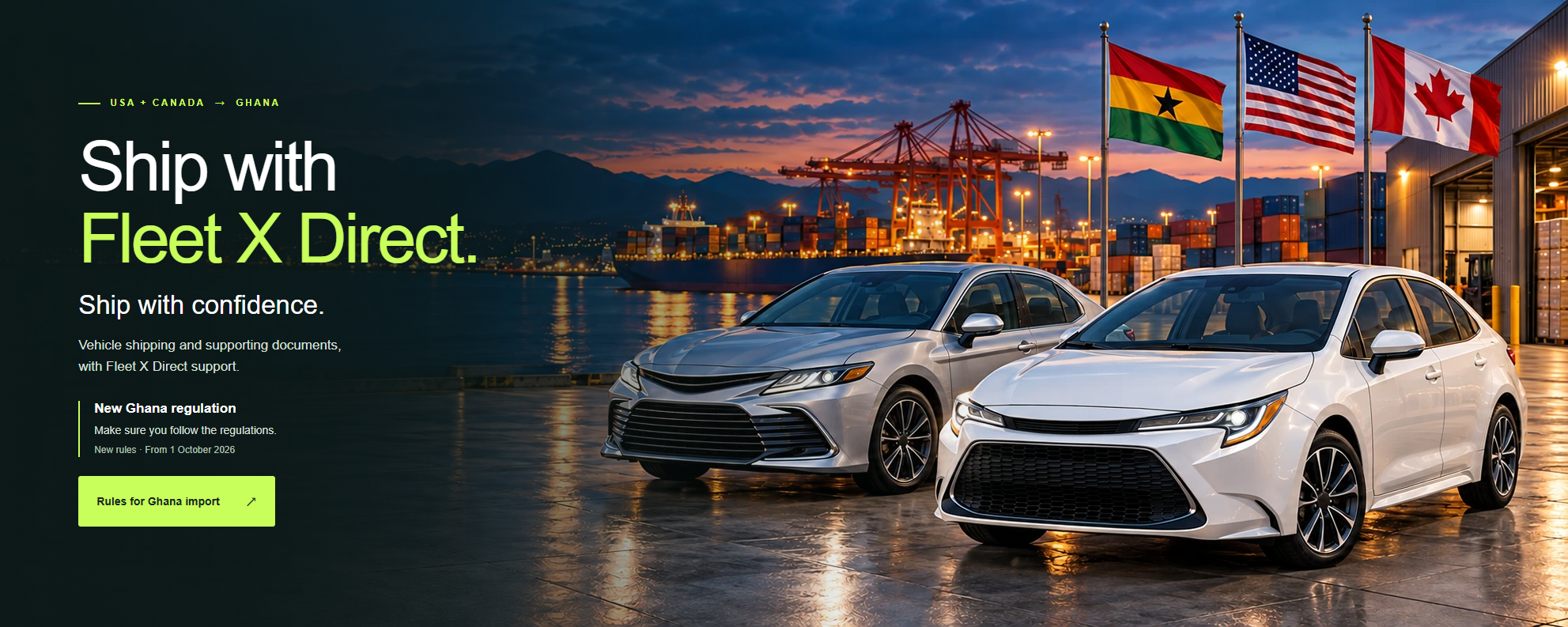
Importing a car into Ghana requires compliance with both Ghana Standards Authority (GSA) vehicle requirements and Ghana Revenue Authority (GRA) customs rules. A clean title, an auction sale or a conformity certificate alone does not establish that every import requirement has been met. This guide covers ordinary passenger vehicles, including cars purchased in the United States and Canada. [1] [2] [3]
New Ghana vehicle import rules: October 1, 2026
GSA’s notice issued on August 14, 2026, schedules enforcement for vehicles shipped on or after October 1, 2026. Notice GSA/DGS/PN/26/09 supersedes earlier communications, including Notice GSA/DGS/PN/26/08. At this article’s review date, the commencement date is still ahead. [1]
Vehicles shipped before October 1 remain outside these new requirements even if they arrive later. Vehicles already in Ghana before that date are also exempt. These arrangements do not waive existing customs obligations; retain evidence of the shipment date. [1] [2]
The announced framework requires GSA registration for personal-use importers, businesses and dealers. Before shipment, used vehicles need an inspection in the exporting country by a GSA-approved body and a Certificate of Conformance (CoC). New vehicle models need GSA homologation based on technical evidence and inspection of sample vehicles. Confirm the correct route before purchase. [1] [2]
What counts as a new or used car?
GSA defines a used vehicle as previously owned and registered, more than 12 months from manufacture, and with mileage exceeding 1,500 km. All conditions apply. Vehicles outside this definition are classified as new. A seller’s “used” description or a clean title alone does not settle which conformity route applies. [2]
Ghana car age limit: 10 years or 15 years?
The two numbers come from different provisions. GSA’s August 2026 administrative framework excludes used vehicles over 15 years old. Separately, the Customs (Amendment) Act, 2020 (Act 1014) provides restrictions for specified vehicles over 10 years, including passenger vehicles under HS 8703 and goods vehicles of 5 tonnes or less under HS 8704. The customs restriction depends on a ministerial legislative instrument and statutory conditions. USTR’s 2026 report records continuing implementation delay. [1] [3] [4]
A vehicle between 10 and 15 years old needs separate checks for conformity eligibility and customs treatment, including any overage charge. Obtain a VIN-specific age assessment before purchase. The GSA notice does not explain the precise age-calculation method, so a model-year label alone cannot decide a borderline case. [1] [3] [5]
Can clean-title, salvage or rebuilt-title cars be imported?
Clean-title cars can be imported when applicable age, condition, conformity and customs requirements are met. Check the vehicle and its history as well as its ownership record. Ghana restricts right-hand-drive imports unless ministerial approval is obtained. [2] [3] [5]
Act 1014 defines a “salvaged motor vehicle” by both physical damage from collision, fire, water or another occurrence and the absence of a clean title. Its commencement provision sets the salvage prohibition six months after commencement of the Act. A salvage or rebuilt auction listing should not be treated as automatically eligible. [3]
GSA identifies major damage that disqualifies used vehicles, but that list is not affirmative permission for every other salvage vehicle: existing statutory import requirements remain in force. Before shipment, obtain written, VIN-specific confirmation of customs admissibility from GRA and conformity eligibility from GSA. This is a recommended verification step, not a blanket exemption. [1] [2] [3]
Which used vehicles are excluded?
- Flood-damaged or submerged vehicles, and burnt or fire-damaged vehicles. [1]
- Vehicles with broken, cracked, bent or twisted chassis or safety cages. [1]
- Vehicles assembled from spare parts, without km/h speedometer readings, or over 15 years old. [1]
- Parts-only, scrap-metal or dismantling vehicles, as identified in GSA’s FAQ. [2]
Passing an auction condition check or paying customs charges does not establish conformity. Non-compliant vehicles face refusal under the announced GSA framework. [1]
How is customs value calculated, and what duty applies?
GRA’s vehicle guidance uses the manufacturer’s first purchase price and an age-based depreciation allowance to determine vehicle value, with freight and insurance included in CIF (cost, insurance and freight). An auction invoice is supporting evidence; its price should not be assumed to equal the customs assessment. GRA’s ICUMS vehicle-duty estimate uses details including VIN, make, model and year. Request an itemized assessment of valuation, tariff classification, exchange rate, duties and levies for the specific vehicle. [5]
GRA’s published passenger-vehicle guidance lists duty bands of 5%, 10% and 20%, depending on engine type and capacity. Act 1014 provides a 35% rate for specified vehicles, subject to its commencement mechanism. USTR’s 2026 report says the necessary implementing regulations had not been enacted when it was prepared. Verify the applicable tariff in ICUMS rather than applying one percentage to every car. [3] [4] [5]
New VAT rules from January 1, 2026
GRA’s 2026 guidance sets VAT at 15%, National Health Insurance Levy (NHIL) at 2.5% and Ghana Education Trust Fund (GETFund) Levy at 2.5%, calculated on the same applicable base. The 1% COVID-19 levy has been abolished. These three components total 20%; they are not the total vehicle-import bill. [6]
| Tax component | Previous system | From Jan. 1, 2026 |
|---|---|---|
| VAT | 15% after levies | 15% on common base |
| NHIL / GETFund | 2.5% / 2.5% | 2.5% / 2.5% |
| COVID-19 levy | 1% | Abolished |
| Combined effective charge* | 21.9% | 20% |
*This comparison concerns VAT and these levies only. For imports, use the legally determined tax base, including applicable non-deductible duties and charges; do not simply apply 20% to the purchase price. [6]
Illustration and other charges
If the correctly assessed common base is GHS 100,000, the components are GHS 15,000 VAT, GHS 2,500 NHIL and GHS 2,500 GETFund: GHS 20,000 combined. This excludes other amounts payable and is not a vehicle quotation. [6]
The customs bill can also include examination fees, overage penalties and applicable AU, ECOWAS, processing, special-import or other statutory levies. USTR reports additional overage charges of 12.5%–20% of CIF for used vehicles above 10 years. Confirm the assessed band and any exemption. Budget port, terminal and clearing-agent charges separately. [4] [5] [7]
Documents and customs clearance
Documents needed to import a car into Ghana
Prepare the vehicle title or ownership document; original Bill of Lading or waybill; attested invoice; packing list where applicable; Import Declaration Form; importer TIN or GhanaCard PIN; and required regulatory permits. Include applicable CoC or homologation documents and evidence supporting the shipment date. Ensure the VIN and importer details agree across the records. [1] [3] [5] [8]
How are customs duties paid?
The clearing agent submits the declaration in ICUMS for classification, valuation and approval. Duties and taxes are paid against the generated tax bill through participating banks. GRA then completes applicable verification, scanning or examination and release procedures. Retain the assessment, payment evidence and release records. A transport booking or informal estimate is not proof that customs payments are complete. [8]
Frequently asked questions
Does personal use remove the GSA requirements?
No. GSA’s programme includes individuals importing for personal use as well as businesses. [2]
Is a repaired salvage car automatically allowed?
No. Repair or a changed title label alone does not establish eligibility under both customs law and vehicle-conformity rules. [2] [3]
Where can I confirm inspection and customs requirements?
Contact GSA’s Vehicle Homologation Unit at auto@gsa.gov.gh for the approved inspection route, and GRA Customs at info@gra.gov.gh for vehicle-specific customs treatment. [2] [8]
Plan your Ghana shipment.
Share the VIN, pickup location, title status, running condition and destination so the inland and ocean scope can be coordinated.
Fleet X Direct supports shipping coordination and document handoffs within the agreed service scope. Import approvals, customs assessments and certificates are determined by the responsible authorities and authorised providers.
Plan your Ghana shipment